
How American bison are built for Buffalo winters
By Adam Gorski
There are few things more synonymous with Buffalo than its unpredictable, rugged, yet also beautiful, winters.
While Western New Yorkers have their own opinions about the cold and snow, a symbol of the city and staple resident of the Buffalo Zoo happens to love it.
American bison are built to not only withstand the toughest of winter conditions, but also thrive in it — and that’s exemplified through our bison trio Dolores, Caroline and Susan.
The crucial winter survival tool for American bison is their thick, wooly coats that develop yearly when the weather begins to turn. These coats protect them from practically anything winter can throw at them, from blankets of snow to harsh winds to freezing temperatures, before it’s shed when the weather breaks.
In fact, it is believed that a bison’s winter coat can be so thick that when snow accumulates on the animal, it will not melt from their body heat.
You don’t have to travel to a wintry Yellowstone National Park to witness these incredible, wooly coats do their job, either.
During snowy days at the Buffalo Zoo, our three bison girls will often choose to hunker down and nap on exhibit while they conserve energy, becoming blanketed in snow. Oftentimes, the girls can be hard to spot as they’ll blend in with the snowy rocks that dot their habitat!
Our bison, like all animals that spend time outside during the winter, have the option to either stick out a winter storm on exhibit, or head into their barn for some warmth. For the three girls, though, enduring the cold is what they’re built for.
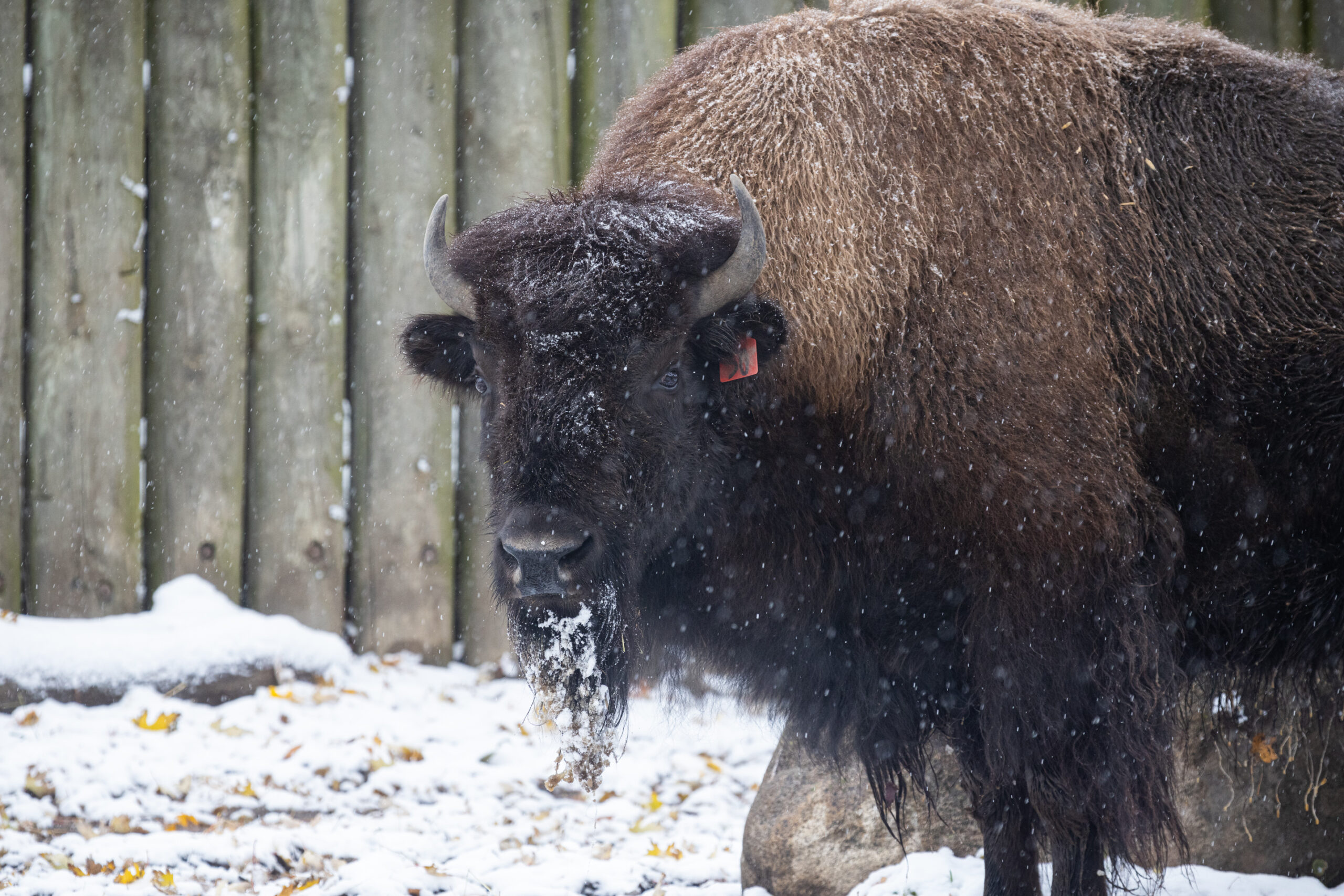
When outside during a windy winter day, most all people would turn to face away from the harsh conditions — but not bison.
The fortified animals will actually lay down and face oncoming wind and snow as they wait for it to pass. Meanwhile, their metabolism adapts and slows down, allowing them to conserve energy.
To forage and navigate during harsh conditions, bison will use their large heads and strong shoulders to plow through snow and get to their main food source: grass and other greenery. It is believed that bison can plow through snow as deep as four feet to get to their food.
Millions of bison once roamed the grasslands and prairies of the Great Plains in the early and mid 1800s, but a devastating slaughter nearly wiped out the species by 1900. However, thanks to integral conservation efforts like protecting the animals in places like Yellowstone, the population has rebounded.
Today, around 30,000 bison reside in wild, conservation-minded herds — a prime example of how impactful conservation can be, and why the Buffalo Zoo will always be devoted to this integral work.
For Dolores, Caroline and Susan, the incredible care of our keepers make things a little bit easier for them compared to the unforgiving nature of the Great Plains, but they are still capable of handling even the toughest conditions Buffalo can throw at them.
Outside of their remarkable survival skills, keepers say the three girls are very curious and love to interact with enrichment given to them. Be sure to see Dolores, Caroline and Susan on a snowy day inside our bison habitat sponsored by the 716 Foundation!


