
What goes into a greater one-horned rhinoceros training session?
By Adam Gorski
Training animals to cooperate in their own care and husbandry is a crucial part of our keepers’ jobs at the Buffalo Zoo, and they work tirelessly to build a strong rapport with the animals that they work with to accomplish that feat.
Whether it’s our smallest or largest residents, each training session presents its own challenges and rewards — including with our youngest greater one-horned rhinoceros, Georgia.
Born here in Buffalo, Georgia has grown up with our hoofstock team and has learned various skills over time thanks to their knowledge and dedication. So what goes into training a rhino?
Arguably the most important part of training any animal is trust, and 4-year-old Georgia has built an incredibly strong connection with our hoofstock team.
Georgia has learned a number of different behaviors through working with hoofstock keepers, many of which are crucial for her to receive proper care and treatment from our veterinary staff.
For instance, one of the skills Georgia has learned is to open her mouth on cue. This behavior helps her care team see deep inside her mouth to see the color of her gums & tongue (critical for determining blood circulation, oxygenation, and overall heath) as well as see her teeth to determine if further dental work may be needed, as plaque buildup and tooth wear are problems in both people and animals!
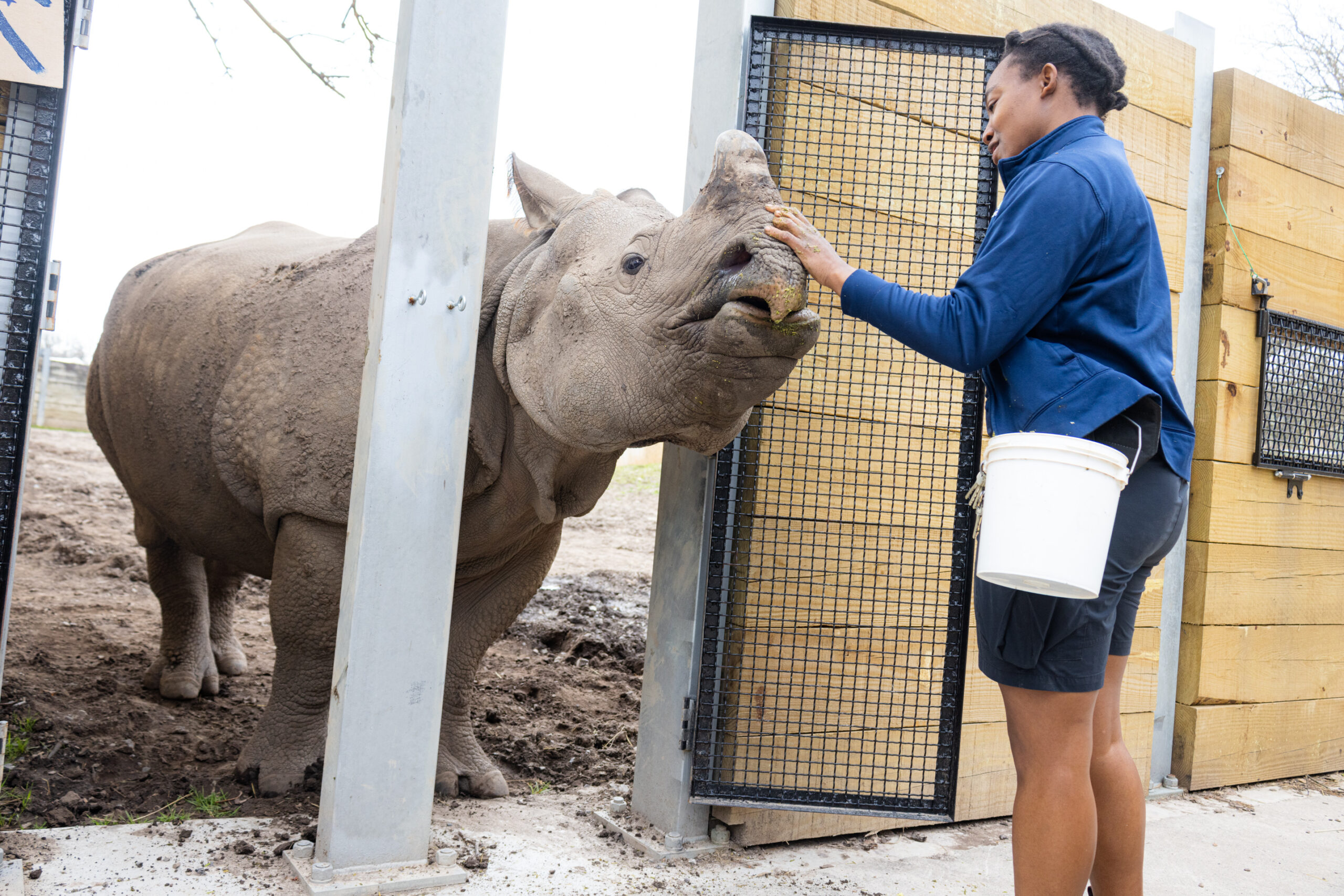
By shaping behaviors in small achievable steps, keepers are able to get Georgia to learn things through repetition… plus the help of some tasty treats, using a method called positive reinforcement training.
Positive reinforcement training is a training method where the keeper acknowledges and reward the behaviors they want with something the animals wants. For example Georgia has been trained to know that when she does something the keeper wants – she will hear a whistle and the whistle will be followed by a rhino treat (carrot, apple, alfalfa cube) or non-food item (favorite toy, or scratch on the back). Georgia gets her normal diet and treats without having to do anything – items used in positive reinforcement training are all extras and extra positive for her.
Not all trainings are planned out, as sometimes they happen naturally like how Georgia learned to put her foot on a wooden box on cue. This stems back to keepers noticing how Georgia would place her foot on salt block completely on her own. By connecting that behavior with a cue, whistle, and reward, Georgia quickly learned what was expected of her and can now perform it when asked, regularly during sessions.
Similar to opening her mouth, Georgia placing her foot on a box can be a major help should keepers need to get a close up look at her hoof, which is one of the more vulnerable parts of a rhino’s body.
While training is important for health reasons, it’s also just as important for mental stimulation and simply having fun!
One of the more entertaining skills Georgia has picked up is playing fetch. Keepers will gently toss a rubber feeding bowl into the habitat, and after being given the fetch cue, Georgia retrieves and brings it back to receive a reward. She can play all day!
Georgia is a very adventurous, curious rhino, but she also has a cautious side too as many rhinos do. Seeing how she has grown, become more comfortable and picked up these various skills is a testament to the dedication and passion of our hoofstock team!


